Staying home
Aging in Place in a Hill Country Home
Almost everyone says they want to stay in their own home. Whether that is realistic depends less on willpower than on three practical things: the house, the transport and the help.
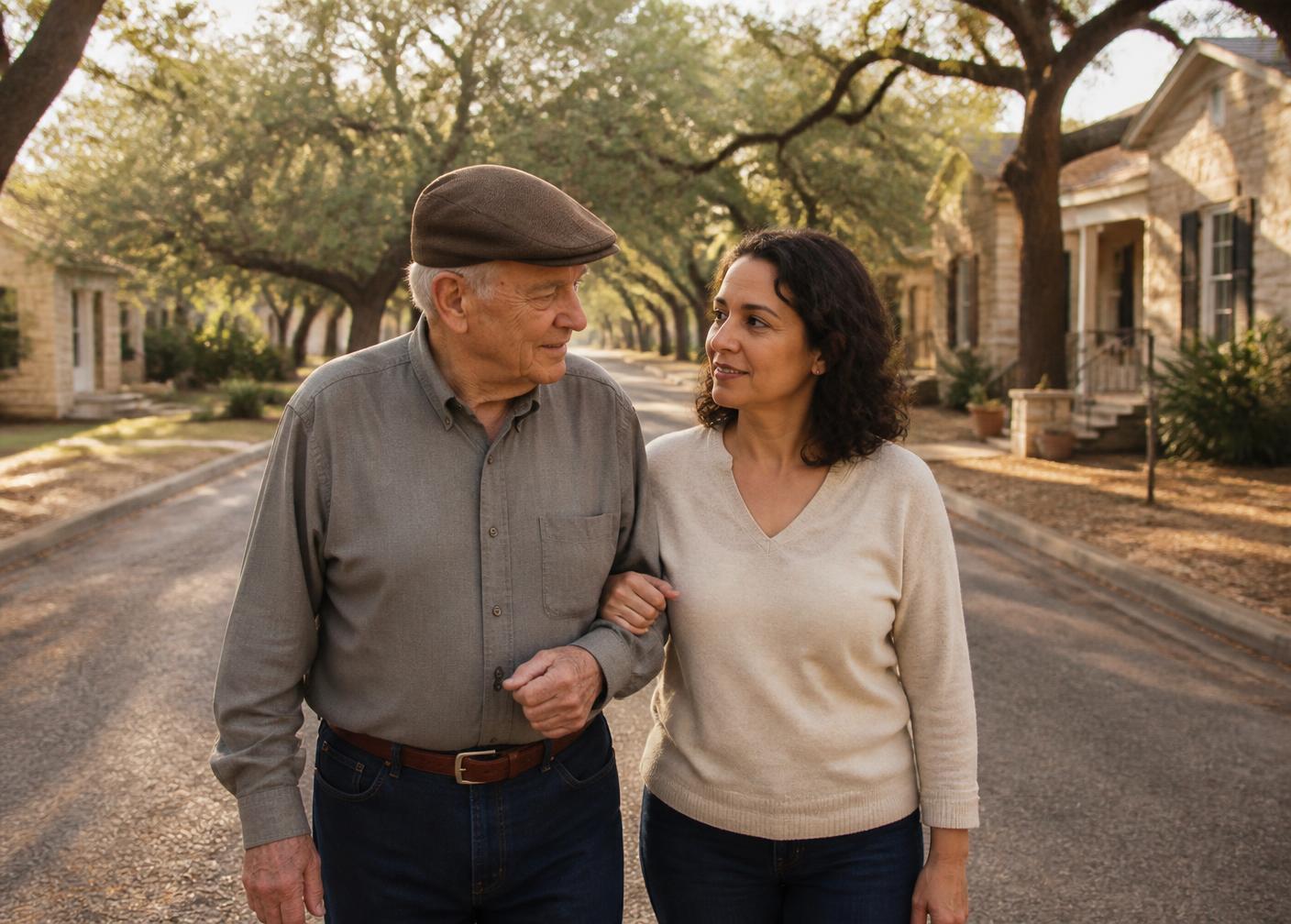
The house itself
Homes around Boerne and Fair Oaks Ranch were mostly designed for people in their fifties. Sunken living rooms, step-down entries, stone paths, wide lots, long hallways and a laundry room at the far end of the house are all normal here, and all become obstacles later.
The good news is that the highest-value changes are cheap. Grab bars properly anchored into studs, a shower chair, better lighting on stairs and at the front door, removing loose rugs, and moving the everyday bedroom to the ground floor solve most of the risk without a renovation.
- Bathroom: grab bars, non-slip surfaces, a shower seat and a handheld shower head.
- Lighting: motion-activated lights on the route from bed to bathroom.
- Floors: remove loose rugs and trailing cords rather than working around them.
- Entry: a handrail at the porch steps, and a properly lit path from the driveway.
- Kitchen: move daily items to waist height so nothing needs a step stool.
Transport is the deciding factor here
In a walkable city, giving up driving is inconvenient. In Kendall County it can be isolating overnight. Groceries, church, the doctor in San Antonio and coffee with friends all sit at the end of a car journey.
Any realistic aging-in-place plan has to answer the transport question directly, whether that is family, neighbours, community transport or scheduled caregiver driving. Postponing the answer is what turns a driving conversation into a crisis.
Social connection is a safety measure
Someone who leaves the house twice a week eats better, sleeps better and is noticed sooner when something changes. Someone who has not been out in a fortnight can decline quietly for a long time.
This is why companion care and scheduled transport tend to appear in aging-in-place plans well before hands-on personal care does.
Be honest about when it stops working
Aging in place is a good default, not an obligation. There are situations where a home cannot be made safe: repeated night wandering, needing two people for every transfer, or a level of confusion where being alone at any hour is unsafe.
Continuous care can bridge some of that, and 24-hour home care explains how. But if the honest answer is that a move is the better option, that is worth facing early. Home care versus assisted living lays the comparison out.
Questions families ask
What is the single most useful change to make first?
The bathroom. It is where the majority of serious home falls happen, and it is also the cheapest room to make meaningfully safer.
Is aging in place cheaper than moving?
It depends entirely on hours. At a few hours a day it is usually less expensive than a private assisted living apartment. At continuous coverage the gap narrows or reverses.
Who can assess our house?
An occupational therapist can perform a proper home safety assessment, usually on physician referral. That is a clinical service and separate from non-medical care.
Work out what staying home would actually require
Describe the house and the week. We will be straight with you about whether hourly help is enough or whether you should be planning for more.
Prefer to talk it through first? Call XXX-XXX-XXXX. No obligation, and no pressure to decide on the call.
Related pages
- Companion CareCompany, conversation, errands and staying connected.Read more
- Personal CareBathing, dressing, grooming and mobility assistance.Read more
- Home Care vs. Assisted LivingStaying put versus moving into a community.Read more
- 24-Hour Home CareContinuous awake coverage across rotating shifts.Read more
- Senior Care ResourcesLocal and statewide places to start looking.Read more
- Home Care in Kendall CountyCoverage across Boerne, Comfort, Sisterdale and beyond.Read more
Looking for something else? Read the FAQ or request care information.